Long blonde hair cascaded from her shoulders to the middle of her back. She was an Italian beauty with skin the color of honey. I’d met her on campus in an advanced writing/communications course, where I was the only freshman in a class developed for juniors. She was two years older than me and the captain of the equestrian team. Her name was Roxanne, and she did for jodpurs what liquid rocket fuel did for the US space program.

Jodpurs-all the right gear, all the time
Besides myself, there were 25 other dim bulbs in this class of literary aspirations. It didn’t matter that I was an unpublished smart ass, who delivered opinions faster than Dominoes delivered pizzas. I still figured I could be a rising star. My first opportunity came when the instructor challenged me to critique the work of another student before the group. I took a breath, glanced around, and started critiquing with a chainsaw. Three minutes later, the deed was done and severed body parts were twitching on the floor. The venerable instructor agreed with my points. And when the class had ended, this blonde came up to me and said:
“I helped that guy write that story. You’re an asshole.”
Some men have great smiles. Other men have bodies like tanned iron. I have a line of bullshit as wide as an airport runway. I’ll take it over the other two every time. Coupled with my patented “clubbed baby harp seal look," it used to deal me into some pretty good games.
“I helped that guy write that story. You’re an asshole.”
Some men have great smiles. Other men have bodies like tanned iron. I have a line of bullshit as wide as an airport runway. I’ll take it over the other two every time. Coupled with my patented “clubbed baby harp seal look," it used to deal me into some pretty good games.

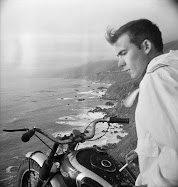
The patented baby harp seal look
Here it was two months later, and this same Italian beauty was straddling the back of my 1975 Kawasaki H2 750 Triple, on her way to spend a night camping in Harriman State Park, some 60 miles away. All I could think of was, “The baby harp seal is not clubbed in vain.”
The 1975 Kawasaki H2 750 Triple remains one of the most primitive and savage machines in biking history. It had the the hurriedly copied lines of a standard British bike and all the mechanical finesse of a chipper. The oil was injected into the cylinders from a tank under the seat and it usually started on the second kick. The choke was a lever on the handlebars, which beat reaching down to find a button somewhere under your balls. It was my first bike, and I had had nothing to compare it with. So it was fantastic.

1975 Kawasaki 750 Triple
The machine was light, powerful, and quick. You could snap your neck or slide right off the seat in four gears. But that two-stroke engine sounded like a lawnmower on steroids and it went everywhere in a cloud of smoke. It had a suspension that made a rough road feel like getting laid on hard ground over a thin sleeping bag. And since that was my weekend objective for most of the time I owned the bike, what was there to complain about?
The only accessory I could afford to put on this bike was a sissy bar and a pad. This kept “Roxanne,” and other women who came later, from becoming the unintentional slide victims of fast starts. It also served as an anchoring point to which camping gear, such as I had, could be secured. On this trip, we carried a cheap tent, a sleeping bag, a blanket, and a plastic bottle filled with vodka and cranberry juice. Nothing but the absolute essentials.
It was after rush hour when we pulled away from the curb, in Rutherford, NJ, on a clear Friday night in late May. We had dinner in a steak joint and roared onto Route 17 at dusk. (It wasn’t really a roar. It was more like, “Yinnnnnnngggggg Ying Ying Yingggggggggggg!”) Traffic was murderous on this road 35 years ago. Yet at 18, I didn’t give it a second thought. Three of the world’s first malls were at the confluence of Rt. 4 and Rt. 17, in Paramus, NJ, which lent a warm, grindhouse atmosphere to the 20 or so feeder ramps that a rider would encounter in that two-mile stretch. (I understand it’s worse now.)
Two-up on a short wheelbase with gear loaded high gave the bike a slightly top-heavy feel that was easily overcome by twisting the throttle. I twisted it all the way up to the New York/New Jersey State line. The terrain changed abruptly at the border. Rt. 17 was a much nicer road in New York. It followed the Ramapo River through the old town of Sloatsburg, which still had a strong sense of independent character in those days.
Seven Lakes Drive -- the entrance to Harriman Park -- loomed on the right, but I didn’t take the turn. The next town up the line is Tuxedo, which was once the home of an exclusive club whose members popularized a certain kind of formal evening suit. My immediate destination was just on the other side of town. The “Red Apple Rest” was an incredible combination of New York City deli and ice cream stand. Buses were welcome. Bikes were welcome. Hell, train crews from the Erie Lackawanna, whose tracks ran in back, were welcome. It was a great place to stop for coffee, or a drink, as this joint had a bar and the drinking age in New York was 18 at the time.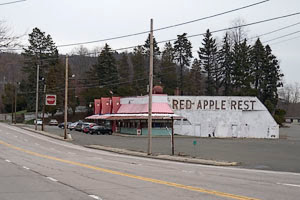
The only accessory I could afford to put on this bike was a sissy bar and a pad. This kept “Roxanne,” and other women who came later, from becoming the unintentional slide victims of fast starts. It also served as an anchoring point to which camping gear, such as I had, could be secured. On this trip, we carried a cheap tent, a sleeping bag, a blanket, and a plastic bottle filled with vodka and cranberry juice. Nothing but the absolute essentials.
It was after rush hour when we pulled away from the curb, in Rutherford, NJ, on a clear Friday night in late May. We had dinner in a steak joint and roared onto Route 17 at dusk. (It wasn’t really a roar. It was more like, “Yinnnnnnngggggg Ying Ying Yingggggggggggg!”) Traffic was murderous on this road 35 years ago. Yet at 18, I didn’t give it a second thought. Three of the world’s first malls were at the confluence of Rt. 4 and Rt. 17, in Paramus, NJ, which lent a warm, grindhouse atmosphere to the 20 or so feeder ramps that a rider would encounter in that two-mile stretch. (I understand it’s worse now.)
Two-up on a short wheelbase with gear loaded high gave the bike a slightly top-heavy feel that was easily overcome by twisting the throttle. I twisted it all the way up to the New York/New Jersey State line. The terrain changed abruptly at the border. Rt. 17 was a much nicer road in New York. It followed the Ramapo River through the old town of Sloatsburg, which still had a strong sense of independent character in those days.
Seven Lakes Drive -- the entrance to Harriman Park -- loomed on the right, but I didn’t take the turn. The next town up the line is Tuxedo, which was once the home of an exclusive club whose members popularized a certain kind of formal evening suit. My immediate destination was just on the other side of town. The “Red Apple Rest” was an incredible combination of New York City deli and ice cream stand. Buses were welcome. Bikes were welcome. Hell, train crews from the Erie Lackawanna, whose tracks ran in back, were welcome. It was a great place to stop for coffee, or a drink, as this joint had a bar and the drinking age in New York was 18 at the time.

Legendary Red Apple Rest
I had a rye and ginger, made by an ancient barman who regarded my drinking at his bar as the end of civilization. Roxanne used the last flush toilet she would see for 14 hours. I was always amazed how every eye in the place followed her wherever she moved. (Please see jodpurs above.)
Fifteen minutes later, we turned onto Seven Lakes Drive. The high beam pierced the darkness like a stiletto. The quivering light cast interesting shadows and converted the road into a black and white movie. I slowed to 50 miles per hour, never giving a second thought to the legions of deer that move about this place. This road was initially put through just prior to the first World War, and the few intersections are marked with tight little traffic circles. Several of these are covered with grass. In daylight, I would be able to see tire marks bisecting a couple of these islands, where motorists had been taken by surprise.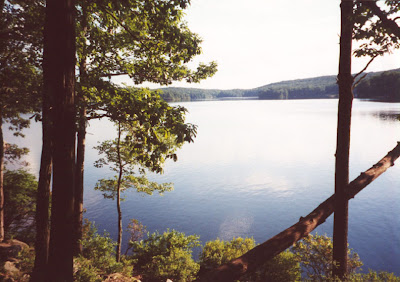
Fifteen minutes later, we turned onto Seven Lakes Drive. The high beam pierced the darkness like a stiletto. The quivering light cast interesting shadows and converted the road into a black and white movie. I slowed to 50 miles per hour, never giving a second thought to the legions of deer that move about this place. This road was initially put through just prior to the first World War, and the few intersections are marked with tight little traffic circles. Several of these are covered with grass. In daylight, I would be able to see tire marks bisecting a couple of these islands, where motorists had been taken by surprise.

One of many beautiful views on Seven Lakes Drive
I have always been amazed by the smells one encounters while riding a bike. There was absolutely no traffic on this particular evening, and the aroma of cooked motor oil was strictly behind me. We plunged through the scent of balsam and pine, the cool aroma of little glades that quickly gave up the heat of the day, and places where new growth was sprouting on the sides of the road. And all of this had to be taken by sense of smell, as it was in the dark.
I was looking for a driveway off to the right, just opposite Narrow Lake, and before the old Silver Mine Ski area. There used to be a huge paved lot that is now blocked off by boulders. The lot could easily hold four hundred cars and I could never understand why it was built. It was also about 15 feet below the grade of the road.
Turning into the lot was almost anticlimatic. There is something about a great little ride that causes one to regret its conclusion regardless if something equally nice is at the other end. I knew this lot well and drove to a copse of trees in the far corner. This was not a legitimate camping area. The bike snarled its way through the brush into a small clearing and I killed the engine.
We set up the spartan tent in the glare of the headlight. It was a $20 Canal Street special without a floor. I methodically spread a ground cloth, tightened the guy lines (such as they were), and tended to the bike while Roxanne spread out the sleeping bag and the blanket. There were no bugs and no threat of rain. Nevertheless, the tent had a distinct $20 look to it, and sagged like Nixon’s popularity. I ran two other lines from the top of each pole to a nearby drooping branch.
“Where’s the vodka,” asked Roxanne sweetly, from inside.
I opened the tent with the bottle, and the light from the headlamp illuminated her naked form, outlining her curves and creating enticing pools of shadow. Laughing, I switched off the headlight and drank in the night air. It is amazing how the perfume of a woman’s body is just the right compliment for the scent of balsam, pine, wild flowers, new growth, and vodka. It pretty much goes with everything.
Looking back at something I learned in grade school, my mind stumbles across the four food groups. I forget what they actually are, but I can tell you what they should be: a good motorcycle, a nice stetch of road, a naked woman, and a well-mixed cocktail. You may dispute this until you are blue in the face, or even add conditions, but you will not be able to improve upon my basic formula.
Everything comes to an end. The wind picked up towards dawn and the trees around us started to protest. There was a crack and a heavy branch tumbled. It was the branch I had guyed the tent poles to. Did you ever see one of those stunts where the waiter pulls the tablecloth from a fully set table without disturbing the plates, glasses, or silverware? Well this was a variation on that theme. The branch tumbled down a little hill, and took the tent with it.
It can be argued that naked women may look great wearing only the light from a bike’s headlamp... But they look pretty good in the plain light of dawn too, even as they scramble in the brush for clothing.
Jack Riepe
AKA The Lindbergh Baby (Mac-Pac)
AKA Vindak8r (Delphi)
PS (With A Shrug)
© Copyright 2008 Jack Riepe -- All Rights Reserved
I was looking for a driveway off to the right, just opposite Narrow Lake, and before the old Silver Mine Ski area. There used to be a huge paved lot that is now blocked off by boulders. The lot could easily hold four hundred cars and I could never understand why it was built. It was also about 15 feet below the grade of the road.
Turning into the lot was almost anticlimatic. There is something about a great little ride that causes one to regret its conclusion regardless if something equally nice is at the other end. I knew this lot well and drove to a copse of trees in the far corner. This was not a legitimate camping area. The bike snarled its way through the brush into a small clearing and I killed the engine.
We set up the spartan tent in the glare of the headlight. It was a $20 Canal Street special without a floor. I methodically spread a ground cloth, tightened the guy lines (such as they were), and tended to the bike while Roxanne spread out the sleeping bag and the blanket. There were no bugs and no threat of rain. Nevertheless, the tent had a distinct $20 look to it, and sagged like Nixon’s popularity. I ran two other lines from the top of each pole to a nearby drooping branch.
“Where’s the vodka,” asked Roxanne sweetly, from inside.
I opened the tent with the bottle, and the light from the headlamp illuminated her naked form, outlining her curves and creating enticing pools of shadow. Laughing, I switched off the headlight and drank in the night air. It is amazing how the perfume of a woman’s body is just the right compliment for the scent of balsam, pine, wild flowers, new growth, and vodka. It pretty much goes with everything.
Looking back at something I learned in grade school, my mind stumbles across the four food groups. I forget what they actually are, but I can tell you what they should be: a good motorcycle, a nice stetch of road, a naked woman, and a well-mixed cocktail. You may dispute this until you are blue in the face, or even add conditions, but you will not be able to improve upon my basic formula.
Everything comes to an end. The wind picked up towards dawn and the trees around us started to protest. There was a crack and a heavy branch tumbled. It was the branch I had guyed the tent poles to. Did you ever see one of those stunts where the waiter pulls the tablecloth from a fully set table without disturbing the plates, glasses, or silverware? Well this was a variation on that theme. The branch tumbled down a little hill, and took the tent with it.
It can be argued that naked women may look great wearing only the light from a bike’s headlamp... But they look pretty good in the plain light of dawn too, even as they scramble in the brush for clothing.
Jack Riepe
AKA The Lindbergh Baby (Mac-Pac)
AKA Vindak8r (Delphi)
PS (With A Shrug)
© Copyright 2008 Jack Riepe -- All Rights Reserved





 Posts
Posts