I had mixed emotions about selling the motorcycle, especially as it meant I’d be giving up the riding lifestyle indefinitely. But I’d had my fun... I was getting older... My interests were changing... And none of my friends were riding much any more. Plus the bloom was off the vine for the 1975 Kawasaki. Known as the “Widow Maker,” it had been the fastest street bike in its day, but that day barely lasted 24 hours. The two-stroke H2 had all the grace and finesse of an early 19th century steam engine. It belched smoke, it made a peculiar noise, and it was the final flare of a style that was being by-passed by motorcycle technology from the second it had been introduced to the showroom floor. Kawasaki already had the Z-900 in the wings and Honda was quickly rewriting motorcycle history with its CB750.
My machine had been kept outside 9 months of the year (for nearly 5 years) and it looked it. A poorly routed battery vent hose had flicked acid onto one of the chrome exhaust pipes, leaving a trail of brass dots for about six inches across the pressed can, which already looked odd owing to a flattened seam that ran top and bottom. Though there wasn’t a dent on it, the machine had been dropped three times (twice in some pretty good crashes). It was a pre-historic street-screamer that never developed a following and had zip for moto-mystique. I originally bought it as a key prop to getting laid. And now, it was actually working against me.
Women have an innate sense of cool, and can tell at a glance — even if they are unfamiliar with a thing — whether it is a cool thing or not. Jet black motorcycles that growled like distant thunder were cool. Motorcycles painted in colors that matched fruit-flavors, and which sounded like lawnmowers that had gotten kicked in the balls, did not. None of them gave a shit how fast it went either. New women I met would look at the bike, shrug, and keep walking. (I think I was riding around on the last H2 sold in North America. I never came across another one.) And the girl I had, a real Mediterranean beauty with skin the color of honey at dusk, was beginning to withhold the one thing I desired above all else as pressure to get ride of the bike.
I was walking around in a near comatose state one Friday night, suffering from DSB (Deadly Sperm Build-up), when I decided to throw in the towel as a prelude to getting my horn honked. I wondered what I could possibly say that would serve as a nipple-hardening accelerant. And then it came to me.
“I’ve decided to sell the Kawasaki,” I said, “while it is still worth a few bucks.”
She looked at me through pools of liquid sienna that were her eyes and asked, “Is this an incredibly cheap ploy to get a little, while building up my hopes?”
I feigned indignity, which was difficult for me to do even then, when my eyes were the natural color of sincerity. “How could you even think such a thing,” I stammered.
“Because you would tell the Pope that ‘shit was blue’ if you thought that would get an instant blow job from me,” she replied.
“Would it,” I asked. “Let’s get him on the phone. I think he’s listed in the book, under 'Pontoon,' or is it ‘Pontiff.’”
She began to slowly lift up her shirt, pausing so just a hint of dual nipple was evident, and said, “Will you let me sell the bike for you?”
Now I hate to admit this, but I do have a weak side, and she was using the cheapest of ploys to one-up my utterly cheap ploy. The truth is that if I had been one of the Indians running things on Manhattan Island when the Dutch showed up, they could have kept the $24 in cheap beads if one of their hotties had offered to model them for me.
“Sure,” I said. “Do I still have to talk to the Pope?” I didn't. And I was amazed at how well my little strategem seemed to worked.
Imagine my surprise when she rolled over at dawn the next day, kissed my neck, and said, “I have a buyer for the bike.”
“Who? How? Did you conduct an auction in here while I was sleeping?”
And then the light came on. I had been the victim of a first class hustle. Now that my wits had been cleared of passion’s haze, I could see how the trap door worked, and how I had been lured onto it.
The naked beauty next to me had a sister who was also a knockout, and this sister had a friend who was in the market for a used motorcycle. And the friend had been informed that there was no reason to look further for a quality bike, as one was coming available shortly.
“How shortly,” I asked.
“They’ll be here to look at the bike in 2 hours,” she smiled. “Wanna shower with me? I’m thinking of shaving my coochie. You could help.”
I was overcome by a feeling of lightheadedness, as the little pilot said, “Relax Jack. I’ve got the controls.”
The “friend” turned out to be a 20-year-old firecracker of a little red head that matched the definition of “tom boy.” Wearing coveralls and a Wallace Beery shirt, “Liz” was first class eye-candy; flat as a board, with the body of a swimmer. She was a hair stylist with two ambitions: to get a college degree and to get a motorcycle. In tow was her husband of two years, a likable sort who owned a lawn mower repair shop. Turns out she’d been riding a Japanese 250 for a year, and was ready to move up to a much bigger bike.
Likable sorts are often paired with firecrackers, but it is an odd combination. The husband didn’t plan on getting a bike but was going to be able to fix this one, whenever it needed it, as two-stroke engines were “his life.” I remember thinking, “When was the last time you fixed a lawn mower that hit 100 miles per hour, you likable asshole?” But I just smiled instead.
Liz straddled the bike, and despite her diminutive size, had no trouble flat-footing it. As I recall, the machine was pretty light. “Can I start it,” she asked.
“Can you,” I replied, warming up the battered baby seal look that I save for special occasions. This got raised eyebrows from my honey, and a passing look of askance from the “husband.” But what it got from her was a dazzling smile, a hint of a blush, and a flash of crystal fire from dazzling baby blues.
She glanced downward at the side of the engine, looking for something.
“The choke is on the handlebars,” I said, pointing to the little lever on the left.
Liz smiled again, unfolded the kick starter, and switched on the ignition. For some women, every movement is an expression of sensuality. She came down on the starter with determination to get in a good solid kick. I could almost see the muscles flex in her leg. It wasn’t necessary. The engine exploded into life on the first kick. (I had just replaced the plugs with the brand new spares.) She duck-walked the bike up and down the sidewalk, getting a feel for the clutch.
“This is so much different from my other bike,” she said. “I want it.”
The likable sort put his hand in his pocket with purpose, and said, “I understand you want $400 for it. I can give you $350.”
Shocked for the second time that day, “It comes with the crash frame, the sissy bar, and the windscreen,” I stuttered.
“Three seventy-five,” said my girlfriend.
He had exactly $375 to the cent, folded over in his pocket. He didn't even count it. The likable sort handed me the cash, while my hot squeeze magically produced the title, which she had fished out of my bedlam of papers sometime previous to this ambush. He disappeared around the corner and pulled up in a pickup, towing a lawnmower trailer. They loaded the bike and split.
“Come on,” said my girl. “We gotta hurry.”
She drove like a woman possessed, out to a furniture store that was holding a huge tent sale. Sofas, easy chairs, kitchen sets, and bedroom ensembles filled a parking lot the size of a football field. She dragged me by the hand through a maze of “red tagged” specials, stopping at a nicely upholstered “wing” sofa in a colonial style. It was marked $375.
“What the fuck...” I started to say.
“Exactly,” she replied, shoving me down into the comfy confines of the new sofa. She sat down next to me, cupped my face in her hands, and covered my lips with her mouth like she was trying to revive me from drowning. There must have been a thousand people milling around, and my girl was attractimg an audience.
“He’ll take it,” she said to the salesman. The audience started to clap. The year was 1979. Customer service was alive and well in America, and the sofa was delivered that afternoon. She tipped the delivery guys $20 and they took the old couch out with them.
“Well how do you like it,” she asked, sitting down next to me in the house that evening. “Are you pissed?”
“Not at all,” I shrugged. This sofa is a big improvement over the other one. And it’s just big enough for the three of us.”
“Three of us,” she asked quizzically?
“You... Me... And your shaved coochie.”
“It was worth it,” she said, kicking off her jeans. “I got rid of that rat bike and that ratty sofa all in one shot.”
Epilogue...
As the poster at the bottom of this blog reads, “Motorcycles make good girls do bad things!” They sure do. Liz became very proficient at riding my old Kawasaki. She rode it to college every day... Where she fell in love with her English professor, who also rode a bike. The two of them were last seen heading west. The likeable sort she'd married early in her life ended up by the side of the road with his pants around his ankles. He should have gotten a bike himself, and rode with her to school each day. Then again, things probably would have ended the same way. But with his own bike, he wouldn't have given a shit, and would have found another redhead.
©Copyright Jack Riepe 2010
AKA The Lindberg Baby (Mac Pac)
AKA Vindak8r (Motorcycle Views)
Sunday, August 22, 2010

Wednesday, August 18, 2010
Pass The Salt...
The Bonneville salt flats are a place of extremes: Extreme heat... Extreme cold... Extreme flatness... Even the vast expanse is extreme, stretching across 30,000 acres of wide open space, ending in a ring of mountains. Mountains that ripple in the waves of heat coming off the endless salt... The rider had seen all of this before. He was here for another reason: Extreme speed. The slight vibration through the padded cockpit seat, and the needle on the tach told him the engine was running. Yet within the confines of the streamliner, and the even tighter fire suit, the rider felt a familiar surge of cold across his chest.
No trace of fear, a stream of ice water was being pumped through cooling coils sewn into his shirt.
The rider checked the instruments again. The 500 horsepower, 3000cc, carbon fiber streamliner barely purred, idling on its twin skids. At his signal, the machine jolted forward, attached to a tow vehicle. The rider retracted the skids (which balanced the machine on its two wheels) by thumbing a “Chinese Hat” switch as the speedo showed 20 mph. Another button from the Vietnam war era released the tow rope as the speedo ticked through 50. The tow vehicle pulled off the course, and he shifted the streamliner into gear.
 Above — "Seven" — On the salt, Dennis Manning's seventh streamliner going through final preparations. (Photo from BUB Enterprises Press Kit)
The gear shift is electronic and is represented by a trigger switch that normally fires machine guns on an F-4 Phantom. (The controls were bought surplus and wired into the machine.) The acceleration is smooth, but utterly abrupt — like being thrown out a fifth-story window. There is a certain exhilaration that every biker knows. It is the feeling that comes from running it out in a lower gear, hitting the red line, and then popping into a higher notch, as the motorcycle draws another breath, digging its claws into the pavement. And part of that exhilaration is the sound of pistons going ballistic.
 Above – The rider, strapped into the streamliner, between the unique controls of "Seven." (Photo from BUB Enterprises press kit)
This rider is no exception, but he has been become accustomed to the sensation of speed on a broader scale. This streamliner breeds speed like congress breeds contempt. Though the seat is splayed like an upholstered shovel and the rider is seat-belted like a fighter pilot, he is still shoved back as the machine winds up for the pitch.
There are purists who may contend that a streamliner is not a real motorcycle with its fully enclosed cockpit, massive internal engine, and landing gear skids... But they are wrong. This 24-foot long streamliner (with tires that cost more than I made in 10 years as a writer) may be a unicorn when it is on its skids, but headed down the salt flats, running on two wheels, it is every inch a motorcycle, just like the one piloted by Burt Munro in 1967.
And all of the risks remain the same.
The salt provides an interesting surface. It can be as hard as asphalt or as crusty as French bread. It is covered with water throughout the early spring and assumes its racing nature at the end of summer. For this event, the course is groomed for an 11-mile stretch. The salt is groomed for speed. It is also groomed for death. Without a tree or a building in sight, the wind blows free across the flats. And sometimes — often in fact — it blows with some authority. It can whip up handfuls of salt on a whim, or influence the course of a two-wheeled shooting star, tearing up the salt on contact patches of two square inches of hardened rubber.
 Above — "Seven" in tow, starting the course at the Bonneville Salt Flats. (Photo from BUB Enterprises press kit)
Fourteen seconds into the course, the rider glanced at the speedo and made a decision: he triggered it into second gear — at 180 miles per hour. Decisions like these would come faster now. He had less than four miles to max this machine out, and it was already doing a little less than half speed.
Bonneville salt flat speed records for motorcycles are born between mile markers #5 and #6. Birth complications sometimes occur when crosswinds shake the nose, causing the machine to swerve. It is amazing how much lateral movement you can get in a machine at speeds over 280 miles per hour, with very little effort.
The machine gun trigger was pulled two more times and the streamliner rocketed into the timed mile at a speed in excess of 350mph. The rider was satisfied that this practice run had shown the machine ready for competition, and began the slow-down process after passing Mile 6. Even in practice, these high-speed runs are the stuff of legend. This one would be no different.
Somewhere around 280 mph, buried deep within the 19 feet of streamliner behind the rider, an oil hose parted, spraying hot parts with lubricant. The engine burst into flames, setting off the fire suppression system. A fire warning light advised the rider that things had taken a dark, and dirty turn. Yet in less time that it took to write these words, the smoking $6 million (plus) machine covered yet another two miles.
It was time to bail out. (Or at least to get out.)
There was no question of killing the engine. It had died by its own hand as the ignition wiring turned to ash. Having trained for contingencies just like this, the rider calmly hit the “torpedo” button, to deploy the pilot ‘chute. This is a small 18-inch parachute that activates the main drag chute. The effects of the sudden drag can be felt immediately.
Nothing happened.
For an instant, the cool water circulating around the rider’s chest didn’t seem quite cool enough. He was faced with a bit of a dilemma. Releasing the emergency back-up drag chute can only be done at a lower speed, as the wind-stream will simply shred it. Now the gentle reader will undoubted think, “Thank God this happened on the Bonneville salt flats, with all that wide open space. All the rider has to do is sit tight until the machine runs out of momentum, then jump out, leaving the smoldering ruins to the fire crew undoubtedly chasing the ill-fated streamliner.” This is a logical conclusion, provided the machine doesn’t blow up winding down.
It would also be the wrong conclusion.
Despite 30,000 acres of vast wide-open space before him, the rider and his streamliner were eating up the groomed course at about 4 miles a minute. The perfectly flat course extended slightly beyond the 11-mile marker, but not by much. Then it quickly yielded to coarser salt, complete with bumps, ridges and cracks that would offer no challenge to a dirt bike. But they might just as well have been cobblestones to the streamliner’s fragile suspension. The rider was under no illusions as to what could happen after mile-marker 11.
Without the thrust of 500-horsepower engine, the machine started to slow, and after the scant seconds required to hold a breath, the rider deemed it safe enough to release the emergency drag chute. It was a bad day for drag chute reliability as that unit also failed to deploy. The slightly disillusioned rider noted that the machine was still moving in excess of 200 mph, with less than three miles in which to stop.
Redundancy is the key word in streamliner technology. And with so many redundant drag chutes on board, there was little consideration for weight-consuming brakes. The streamliner has a back brake that the rider regards as useless for any speed faster than a brisk walk. With a touch as gentle as the lead man for the bomb squad, the rider carefully began to extend the skids. Sudden drag behind the front wheel can dramatically change the manner in which the streamliner handles. Fighting erratic steering with one hand, and nursing the skids with the other, the rider divided speed into remaining distance to determine if he would still need his dinner reservations that night.
The streamliner came to a stop about a half mile from the first line of cracks and ridges.
It had to stop. The skids were buried eight inches into the salt. The rider exited the streamliner with as much elán as could be mustered under the circumstances. The fire had been extinguished and the pit crew began to assess the damage to the machine.
More than anything else, the rider was disappointed by the thought that the damage done to the engine would have precluded competing for the title of “World’s Fastest Man on Two Wheels,” an honor that presently belonged to a competitor. Yet as he removed his helmet and gloves, the rider smiled sheepishly, scuffed the salt with his boot, and asked, “Who packed the drag chutes?”
Now, the average guy might have been inclined to rethink the details of the afternoon and decide that other pastimes could be more gratifying. But this rider is not the average guy. He won the 1992, 1999, and 2001-2005 AMA Grand National Dirt Track (Flat Track) championships, the 2000 Formula USA Dirt Track Championship and the AMA 600cc Dirt Track championship seven times (1988–1993, and 1995). He won his first Grand National Championship when he was 19.
 Above — Chris Carr, the World's Fastest Man On Two Wheels. (Photo from BUB Enterprises press kit)
So two weeks later, on September 24th, 2009, Chris Carr strapped his butt into a repaired streamliner (owned by Dennis Manning of BUB Racing) and rode into high-speed history, at 367.382 miles per hour. He is currently the “World’s Fastest Man On Two Wheels.”
Nothing burned and the drag chutes worked... But that doesn’t mean it was routine. There’s always the wind. (To be continued...)
 Above — From left, the author, Chris Carr, and James Ellenberg, who is a tee shirt salesman, attempting to make a buck. Note Riepe is holding a cane and Ellenberg is sporting a crutch. Carr has asked Riepe for advice on leaning into high-speed curves. Riepe is lying as he has never leaned into a curve in his life. The author is pleased to report he is no longer that fat. (Photo by Ansel Adams Schwartz)
 Above — One of the author's favorite pictures, as a guest in Chris Carr's pit at Hagerstown Raceway. The author is now 25 pounds lighter than he was in the picture. Here he has more chins than a Chinese phonebook. (Photo by Jim Ellenberg)
©Copyright Jack Riepe 2010
AKA The Lindberg Baby (Mac Pac)
AKA Vindak8r (Motorcycle Views)
No trace of fear, a stream of ice water was being pumped through cooling coils sewn into his shirt.
The rider checked the instruments again. The 500 horsepower, 3000cc, carbon fiber streamliner barely purred, idling on its twin skids. At his signal, the machine jolted forward, attached to a tow vehicle. The rider retracted the skids (which balanced the machine on its two wheels) by thumbing a “Chinese Hat” switch as the speedo showed 20 mph. Another button from the Vietnam war era released the tow rope as the speedo ticked through 50. The tow vehicle pulled off the course, and he shifted the streamliner into gear.
 Above — "Seven" — On the salt, Dennis Manning's seventh streamliner going through final preparations. (Photo from BUB Enterprises Press Kit)
The gear shift is electronic and is represented by a trigger switch that normally fires machine guns on an F-4 Phantom. (The controls were bought surplus and wired into the machine.) The acceleration is smooth, but utterly abrupt — like being thrown out a fifth-story window. There is a certain exhilaration that every biker knows. It is the feeling that comes from running it out in a lower gear, hitting the red line, and then popping into a higher notch, as the motorcycle draws another breath, digging its claws into the pavement. And part of that exhilaration is the sound of pistons going ballistic.
 Above – The rider, strapped into the streamliner, between the unique controls of "Seven." (Photo from BUB Enterprises press kit)
This rider is no exception, but he has been become accustomed to the sensation of speed on a broader scale. This streamliner breeds speed like congress breeds contempt. Though the seat is splayed like an upholstered shovel and the rider is seat-belted like a fighter pilot, he is still shoved back as the machine winds up for the pitch.
There are purists who may contend that a streamliner is not a real motorcycle with its fully enclosed cockpit, massive internal engine, and landing gear skids... But they are wrong. This 24-foot long streamliner (with tires that cost more than I made in 10 years as a writer) may be a unicorn when it is on its skids, but headed down the salt flats, running on two wheels, it is every inch a motorcycle, just like the one piloted by Burt Munro in 1967.
And all of the risks remain the same.
The salt provides an interesting surface. It can be as hard as asphalt or as crusty as French bread. It is covered with water throughout the early spring and assumes its racing nature at the end of summer. For this event, the course is groomed for an 11-mile stretch. The salt is groomed for speed. It is also groomed for death. Without a tree or a building in sight, the wind blows free across the flats. And sometimes — often in fact — it blows with some authority. It can whip up handfuls of salt on a whim, or influence the course of a two-wheeled shooting star, tearing up the salt on contact patches of two square inches of hardened rubber.
 Above — "Seven" in tow, starting the course at the Bonneville Salt Flats. (Photo from BUB Enterprises press kit)
Fourteen seconds into the course, the rider glanced at the speedo and made a decision: he triggered it into second gear — at 180 miles per hour. Decisions like these would come faster now. He had less than four miles to max this machine out, and it was already doing a little less than half speed.
Bonneville salt flat speed records for motorcycles are born between mile markers #5 and #6. Birth complications sometimes occur when crosswinds shake the nose, causing the machine to swerve. It is amazing how much lateral movement you can get in a machine at speeds over 280 miles per hour, with very little effort.
The machine gun trigger was pulled two more times and the streamliner rocketed into the timed mile at a speed in excess of 350mph. The rider was satisfied that this practice run had shown the machine ready for competition, and began the slow-down process after passing Mile 6. Even in practice, these high-speed runs are the stuff of legend. This one would be no different.
Somewhere around 280 mph, buried deep within the 19 feet of streamliner behind the rider, an oil hose parted, spraying hot parts with lubricant. The engine burst into flames, setting off the fire suppression system. A fire warning light advised the rider that things had taken a dark, and dirty turn. Yet in less time that it took to write these words, the smoking $6 million (plus) machine covered yet another two miles.
It was time to bail out. (Or at least to get out.)
There was no question of killing the engine. It had died by its own hand as the ignition wiring turned to ash. Having trained for contingencies just like this, the rider calmly hit the “torpedo” button, to deploy the pilot ‘chute. This is a small 18-inch parachute that activates the main drag chute. The effects of the sudden drag can be felt immediately.
Nothing happened.
For an instant, the cool water circulating around the rider’s chest didn’t seem quite cool enough. He was faced with a bit of a dilemma. Releasing the emergency back-up drag chute can only be done at a lower speed, as the wind-stream will simply shred it. Now the gentle reader will undoubted think, “Thank God this happened on the Bonneville salt flats, with all that wide open space. All the rider has to do is sit tight until the machine runs out of momentum, then jump out, leaving the smoldering ruins to the fire crew undoubtedly chasing the ill-fated streamliner.” This is a logical conclusion, provided the machine doesn’t blow up winding down.
It would also be the wrong conclusion.
Despite 30,000 acres of vast wide-open space before him, the rider and his streamliner were eating up the groomed course at about 4 miles a minute. The perfectly flat course extended slightly beyond the 11-mile marker, but not by much. Then it quickly yielded to coarser salt, complete with bumps, ridges and cracks that would offer no challenge to a dirt bike. But they might just as well have been cobblestones to the streamliner’s fragile suspension. The rider was under no illusions as to what could happen after mile-marker 11.
Without the thrust of 500-horsepower engine, the machine started to slow, and after the scant seconds required to hold a breath, the rider deemed it safe enough to release the emergency drag chute. It was a bad day for drag chute reliability as that unit also failed to deploy. The slightly disillusioned rider noted that the machine was still moving in excess of 200 mph, with less than three miles in which to stop.
Redundancy is the key word in streamliner technology. And with so many redundant drag chutes on board, there was little consideration for weight-consuming brakes. The streamliner has a back brake that the rider regards as useless for any speed faster than a brisk walk. With a touch as gentle as the lead man for the bomb squad, the rider carefully began to extend the skids. Sudden drag behind the front wheel can dramatically change the manner in which the streamliner handles. Fighting erratic steering with one hand, and nursing the skids with the other, the rider divided speed into remaining distance to determine if he would still need his dinner reservations that night.
The streamliner came to a stop about a half mile from the first line of cracks and ridges.
It had to stop. The skids were buried eight inches into the salt. The rider exited the streamliner with as much elán as could be mustered under the circumstances. The fire had been extinguished and the pit crew began to assess the damage to the machine.
More than anything else, the rider was disappointed by the thought that the damage done to the engine would have precluded competing for the title of “World’s Fastest Man on Two Wheels,” an honor that presently belonged to a competitor. Yet as he removed his helmet and gloves, the rider smiled sheepishly, scuffed the salt with his boot, and asked, “Who packed the drag chutes?”
Now, the average guy might have been inclined to rethink the details of the afternoon and decide that other pastimes could be more gratifying. But this rider is not the average guy. He won the 1992, 1999, and 2001-2005 AMA Grand National Dirt Track (Flat Track) championships, the 2000 Formula USA Dirt Track Championship and the AMA 600cc Dirt Track championship seven times (1988–1993, and 1995). He won his first Grand National Championship when he was 19.
 Above — Chris Carr, the World's Fastest Man On Two Wheels. (Photo from BUB Enterprises press kit)
So two weeks later, on September 24th, 2009, Chris Carr strapped his butt into a repaired streamliner (owned by Dennis Manning of BUB Racing) and rode into high-speed history, at 367.382 miles per hour. He is currently the “World’s Fastest Man On Two Wheels.”
Nothing burned and the drag chutes worked... But that doesn’t mean it was routine. There’s always the wind. (To be continued...)
 Above — From left, the author, Chris Carr, and James Ellenberg, who is a tee shirt salesman, attempting to make a buck. Note Riepe is holding a cane and Ellenberg is sporting a crutch. Carr has asked Riepe for advice on leaning into high-speed curves. Riepe is lying as he has never leaned into a curve in his life. The author is pleased to report he is no longer that fat. (Photo by Ansel Adams Schwartz)
Author's Note:
• Chris Carr speaks softly, with a slight California drawl. (This is because he is originally from California.) He wanted to make it clear that the reason the drag chutes failed was due to extensive damage as a result of the fire. And he suspected so at the time.
• This is what my work looks like when I write a serious motorcycle story. Is everyone happy now?
 Above — One of the author's favorite pictures, as a guest in Chris Carr's pit at Hagerstown Raceway. The author is now 25 pounds lighter than he was in the picture. Here he has more chins than a Chinese phonebook. (Photo by Jim Ellenberg)
©Copyright Jack Riepe 2010
AKA The Lindberg Baby (Mac Pac)
AKA Vindak8r (Motorcycle Views)
Monday, August 16, 2010
The Crowning Incentive...
The ride was nearly over with a scant five miles to go. It was 94º in the air above the pavement but the ground itself was a degree or two below the flash point and the odd droplet of sweat that found its way down to my gas tank danced like a bead of hot oil on gritty diner grill. Vintage BMW K-75s tend to run warm under the best of circumstances, with their gas tanks taking on the characteristics of miniature hot water heaters. This is a delight in the late fall but a total bitch in stagnant summer heat. On the day that these events occurred, riding “Fireballs” was very close to understatement.
If the heat was hard on me, it was worse for some of the cagers around me, even if they appeared to have air conditioning. For example, there was a nice lady in a minivan next to me, who for the sake of this column, I’ll call “Amelia Stupidbitch.” The windshield on her vehicle focused the sun on her forehead — rather like a magnifying glass strategically held over an ant — and boiled her brains. She was on the telephone, probably calling a neurologist, as her minivan swerved ever so gently from side to side. I was in the process of passing her when she came far left as if she wanted a kiss.
Now I’ll kiss most women, and be grateful for the opportunity, but I like to choose my subjects as well the circumstances. (I almost wrote the word “location” instead of “circumstances,” though one most always has to start on the lips, especially with strangers.) We live in an age of political correctness (a philosophy evident in my writing) and it pays to get clarification of intent, especially in dealing with forward women. I sought clarification by triggering the FIAMM sport screamer, a little horn which shrieks like a mother-in-law being staked into a coffin.
As it turns out, that was the right thing to do.
Amelia jumped three feet in her seat and stared at me with her mouth wide open. She was about 35-years-old, and blond with deep red Anjolina Jolie lips times three. With the right lighting (subdued), music (Blue Oyster Cult), and rum (1.5 gallons) this could have been a audition. It was apparent this response came too easily for her. (Opening her mouth is what Amelia uses as a substitute for thought.) Plus in this pose, she looked like a large mouth bass in search of a hook. It was also clear that Amelia did not expect to see a motorcycle two inches beyond her left mirror. I know she was surprised because I could hear her say as much into the phone.
“Fireballs” was clocking a modest 68mph at the time, and I opened the throttle wide. There was a second before the wind-up, and then the pitch. My line drive put a dozen cars between her and the K75. Amelia was left to her perpetual slalom in my wake.
I had been making this short summer morning run with a few of the boys, notably “Leather” Dick Bregstein and Bobby “Le Dauphin” Le Boutlier, both on imposing traditional BMW “R” bikes. They had peeled off as we hit their respective exits and I was alone with 20,000 other drivers on US-202. It was then I noticed that every second vehicle around me was a minivan. Nine times out of ten, vehicles that cut in front of me are minivans. There has to be some explanation. I have documented that virtually every minivan operator has that cross-eyed, over-hanging brow look common to people of low intellect. Now I want to know: does this affliction happen naturally as a side-effect of driving a minivan; or do dealerships just sell these cars to dopey neanderthals; or do you get a free lobotomy with every minivan purchase?
This raises the issue that if the number of stupid, vapid, and inconsiderate drivers is on the rise, should I not be more visible with regard to my riding gear?
Despite the fact a healthy percentage of BMW jockeys order their ballistic riding gear in “high-viz colors,” I still cannot reconcile myself to wearing a jacket that appears to glow like electrified piss. Not on a highly-dignified, cardinal-red motorcycle like mine. That I ride a BMW motorcycle at all already marks me as an elitist douche in the eyes of many riders consigned to lesser sophisticated, more cumbersome, louder, and slower marques. I’ll not go out of my to support their argument by wearing a neon circus sign. So my gear — mesh jacket, perforated glove, and helmet — is the traditional biker black. On a hot, clear summer day, this gear converts sunlight into sweat and steam. The mesh vents this vapor, which instantly condenses and causes lowland flooding. But the sweat shooting out my ears is contained in my helmet, much the same way that BP’s cap is finally holding the oil in that well under the Gulf of Mexico.
There are some folks who regard their riding gear as part of their persona. To me, my riding jacket is my insurance to avoid 50 square yards of plastic surgery should I pull an abrupt flying dismount. It is like a bullet-proof sack. I have mentioned the gloves before. They are the coolest (temperature-wise) I could find, with a zillion perforations, though they offer minimal protection. But I feel differently about my helmet.
If a motorcycle is considered to be the signature of a rider’s character, than his (or her) helmet is that signature’s flourish. (If you were born after 1954 or are a product of the current US education system, you are probably unaware that early 18th and 19th century signatures were often accompanied by a little embellishment, known as a “flourish.” One of the best examples of this can be found under the signature of John Hancock, on the Declaration of Independence.)
 Above — John Hancock, a Founding Father of the United States, knew how to sign a document with style. Portrait from the internet.
My Nolan N-102e helmet is the best motorcycle riding headgear I have ever worn. It is my flourish. I would no more ride out of this driveway without my Nolan helmet than I would ride balls-ass naked. Prior to 2006, I have always worn traditional, open-faced motorcycle helmets, with cheap, shitty plastic face shields that snapped onto the front, or equally shitty goggles. Full-face helmets struck me as claustrophobic, sweat traps that impeded your peripheral vision. And in truth, I wore the cheapest helmet I could find, solely to satisfy local law — despite having had three accidents which entailed hitting the ground. (As stupid kid who routinely kept his head in his ass, I longed to ride helmet-free, on a Kawasaki 900, with the wind blowing through my long hair, and through the halter top of the tanned babe behind me.)
 Above — John Hancock's signature on the Declaration of Independence, large enough so "Fat George" could read it without his glasses. Signature from the internet.
Then came the day I took the Harley-Davidson “Riders Edge” Course. The temperature peaked at 38º, and the pouring rain was an added bonus. Cold rainwater was blowing in around my goggles and aggravating the shit out of me. I walked into the dealer’s showroom and bought a Harley-badged flip-face helmet. The fit was a little off, but I was amazed at the comfort and the quiet of the helmet. It did tend to fog up, but otherwise did nothing to limit my vision or what I could hear. I wore that helmet a month, discovering it was for a round, Charlie Brown-type head and that it did nothing to help me with the sun in my eyes. (I cannot wear sunglasses when I ride, as my eyes take too long to adjust to a shady stretch, or to tunnels.)
The Nolan N-102e was the first brand I tried (and I tried a dozen of them) that fit my lupine shaped-head. The internal padding, the collar in the back, and the gasket seal around the clear, optically correct face shield were all pluses, as was the solid steel to steel locking mechanism, that requires two fingers to hit opposing tabs to open the chin bar. (This eliminates accidently opening the helmet by randomly touching the chin bar.) The foam liner was also alleged to be easy to remove for cleaning. The helmet comes with a trap door to easily install the Nolan brand communications package as well. One of the best aspects of this lid was an external, deep green-tinted sun visor, which flipped down in an instant, to shield your eyes from glare of from the sun, and then popped up just as quickly. It was as if this helmet had been hand-made for me.
Now there are those who do not think this is a beautiful helmet because of the external visor. And there are others who think the external visor makes the helmet noisy. Then again, there are those who fail to see the beauty of a BMW K75. In this rare instance, I did not let the cool element overwhelm practicality. And so began my love affair with Nolan helmets.
On this particular day, I pulled into the driveway and parked the bike. I pulled an ice cold sugar-free Snapple lemonade out of the garage ‘fridge, took a huge gulp, and topped off the void in the bottle with two or more ounces of nice fresh gin. I headed out to the patio to light up a vitamin C-loaded cigar and reflect on the wonders of life. I piled my mesh jacket on an empty chair, and nestled my treasured Nolan helmet securely in the jacket, with the opening facing upward. I was barely ensconced in reverie when Leslie/Stiffie (my red hot squeeze) summoned me inside to the phone. (Brian Curry, a world famous K-75 guru, was on the line and wanted my advice about switching out a clutch plate.) I was in the midst of telling him how to go about this, when I heard Leslie screaming her heart out in horror.
The yard was filled with dead birds.
At least 50 cardinals, gold finches, blue jays, silver-throated sparrows, a flock of Canada geese and a neighbor’s prize-winning emu were dead on the ground. Not only that, but the leaves on our beautiful shade maple were turning brown, curling, and falling off the tree. It was then we noticed a mysterious green vapor emanating from the foam liner of my Nolan helmet.
“The sweat stink from your helmet is killing all forms of life,” said Stiffie/Leslie in a muffled tone, as she was now wearing a WWII gas mask. “Do something before the yard is declared a superfund site. And don’t even think about bringing that foul-smelling helmet back into the house.”
The aroma arising from my helmet, now in its 3rd season of use, was as deadly as mustard gas. But like the most powerful fart ever released at a chili festival, it is common man-lore that the source of the vapor is immune to its effects. I picked up the helmet and tried to look at it objectively (without the tint of affection). The external green visor was covered with a fresh layer of dead bugs... But underneath that, it bore the scratches and scars of 30,000 miles. The clear plastic face shield was in worse shape, and the helmet’s fine finish was well-marred in a dozen places where stones and huge dead bugs had left their marks. (Every flying insect, from the tiny Amish horse-shit midge to the huge, dreaded Fried Rice Beetle — named for the stringy smear of guts they leave behind — leaves a dot of digestive acid where it expired. This can play hell with the exquisite finish of a helmet, or a fairing for that matter.)
The experts (who are probably hired by helmet companies) recommend retiring a helmet after 4 or 5 seasons, as the effects of ultraviolet light can weaken the molecular structure of the plastic. (It’s odd that this takes 50,000 years to accomplish with discarded plastic soft-drink bottles in garbage dumps.) Naturally, you are well advised to replace any helmet that has been through a crash or even dropped hard. The stink coming off my helmet was so bad, my first thought was to go online to see what Nolan was offering, and to determine how much washing Leslie/Stiffie would have to take in to buy me a new one.
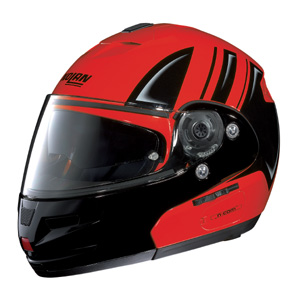 Above — the red and black N-103 n-com I initially fell in love with. Then I discovered the red didn't match the red of my bike. Fate never misses a chance to spit in my eye. Helmet picture from the internet.
The N-102e is still available, but there is a much snappier N-103 n-com with better venting and an internal sunscreen. My computer opened to one that was red and black, and I got an instant, raging hard-on. My bike is red and black, and for once, I thought it would be cool to have a helmet that perfectly matched the paint on my bike. I damn near ordered this helmet with money that was reserved for my first former mother-in-law’s burial plot. (She is still alive and shows no signs of gasping, but I thought I would surprise her with a nice hole in the ground and let her take a two-week test drive.) Then I did the smart thing and carried my laptop into the garage. My bike is a deeper red than that of the helmet, and the match is not quite perfect.
I started to cry.
I decided that a new Nolan helmet, in simple flat graphite, would be my incentive gear... That I would buy one, and keep it in the box until I broke 300 pounds. (I am in a desperate lifestyle change to lose weight.) I have 46 and a half pounds before I hit the 300 pound mark. That’s when I got the great idea. Nolan does not appear to have a custom painting option. But I thought I would don sackcloth and ashes, and kneel in front of their facility, wherever the hell it is, and beg them to sell me a blank unassembled helmet shell that could be painted with my BMW bike’s official paint. (BMW touch-up paint for my bike is available in a one ounce container for about $30. To buy enough paint to do a helmet should cost about $1800. I would ask an air brush artist to put some unique graphics on the painted shell, for another $300.) Then I was thinking I could send the blank back and have the chin-bar attached to it. This is solid black and will look utterly balls-ass. I figure the cost of the helmet, plus the paint, plus the graphics will come in around $3,450.00.
It will be so fucking worth it.
On the day that I officially weigh 299 pounds, I will stand on a huge scale (in the foyer of Michael’s Diner on Rt. 422), and be crowned by a hottie, wearing a shamelessly tight Twisted Roads Tee Shirt. Camera flashes will fire as the sacred Nolan is placed upon my head. (It will probably be stolen 20 minutes later.)
In the meantime, I ordered a new face shield, a new tinted visor, and a anti-fog shield for my existing Nolan-102e. A friend of mine is a member of the local bomb squad, and he came over with one of those little robots designed to handle strange packages. It removed the liner from my helmet and placed it in the washer. The water turned to foam the instant it came into contact with the fouled material. Set to “handwash,” 80 percent of the stench was gone two hours later. I do not believe that these helmet liners are intended to go through the dryer, but this one was getting a bit stretched out. So I ran it through “damp dry” and it tightened up nicely.
Does the gentle reader think that removal of 80 percent of the stench would pass muster around here? Not a shot. I was awakened by what sounded like a dog fight in the kitchen yesterday. “What the hell is going on,” I asked Leslie/Stiffie, in the romantic way we we address each other in the morning.
“The dogs are attempting to roll in your Nolan helmet,” she replied.
The liner is going through a second pass in the washer today. I wonder why the helmet liners are not as readily available as replacement gear as are the face shields. Somebody should put a bug in Nolan’s ear. In fact, I think the folks at Nolan could make a good buck selling complete revitalization kits each spring. These would include the face shield, the anti-fog insert, the tinted visor, and the liner insert. I’d have paid $130 to get all this as one kit. You don’t realize how the scratches and the scuffs, tiny as they may be, pile up on a face shield. But I tried the helmet on with all the new stuff and it was like getting a new pair of eyes. The new face shield, the visor, and the anti-fog shield ran me around $90 at Genuine Accessories. It was money well spent.
Two words on the Nolan anti-fog shield... It works. I breathe through a facial blow-hole, at a rate that rivals a squirrel in coitus, and the shield on a previous “Brand X” flip-face helmet would have the clarity of a bowl of milk in 20 seconds. Not so with the Nolan. I have only experienced fogging about the size of a thumbnail, directly under my nose, under the most taxing circumstances. Cracking the shield a half-notch clears it instantly. There is never any fog to speak of on the Nolan anti-fog shield.
Author’s note:
I have been advised to add a little vinegar (in the bleach port) to the wash cycle the next time I launder this helmet liner. I’m curious to see how this pans out.
I refuse to debate whether it is better to wear a helmet or to ride free in the breeze. I would never tell an established rider that he or she would be smarter to wear a helmet. (For one thing, you cannot tell an established rider anything. It is easier to change someone’s sexual orientation than it is to influence an opinion when it comes to helmets.) But I would tell any newcomers to the riding lifestyle to try this simple experiment. From a car moving at 45 miles per hour, drop a watermelon onto the road. Now repeat the experiment, using your head. (Please don’t really drop your head onto the road from a moving car! My legal department tells me that a certain percentage of Twisted Roads readers are fully capable of dropping their heads on the road. If you can function without your head, then I suggest you put it up your ass for safekeeping and move to Washington, D.C. You have a career in Congress.) To those of my readers who like to ride helmet-free, I say, “Ride on, and ride like hell.” Give me a Nolan flip-face helmet every time.
I received no funding nor promotional consideration from Nolan regarding this column. Not because I am above it, but because no one offered. No amount of money would induce me to endorse a product that I myself wouldn’t and didn’t use. For a person with my head size and requirements, I ranked the “Nolan” helmet as a great helmet. I’d feel confident comparing this helmet against any other brand that fit.
Addendum:
And now the moment you have all been waiting for... Contest Winners!
The winner of the EZ Tire Pressure Gauge is:
STACY
The winner of the Progressive Suspension & Tire Plugging Kit is:
Tom McLarney
Each winner has 15 minutes to contact me at JPRiepe@aol.com, or else I’m selling their prize to piss away the cash on cheap whiskey and tough whores. (Just kidding... The whores are rather sweet.)
The new Twisted Roads monthly contest for September officially starts today. The prize for leaving a comment will be an EZ Tire Pressure Gauge.
The Grand Monthly Prize will be awarded to the most interesting letter written to “Twisted Roads, Dispatches From The Front Department." For examples of sample letters, please click here. The Grand Monthly Prize for September will be a genuine Cycle Pump compressor. Two second prizes will also be awarded. They are copies of my self-improvement book, "Politicaly Correct Cigar Smoking For Social Terrorists." Two third prizes will be coveted "Twisted Roads" tee shirts.
If the heat was hard on me, it was worse for some of the cagers around me, even if they appeared to have air conditioning. For example, there was a nice lady in a minivan next to me, who for the sake of this column, I’ll call “Amelia Stupidbitch.” The windshield on her vehicle focused the sun on her forehead — rather like a magnifying glass strategically held over an ant — and boiled her brains. She was on the telephone, probably calling a neurologist, as her minivan swerved ever so gently from side to side. I was in the process of passing her when she came far left as if she wanted a kiss.
Now I’ll kiss most women, and be grateful for the opportunity, but I like to choose my subjects as well the circumstances. (I almost wrote the word “location” instead of “circumstances,” though one most always has to start on the lips, especially with strangers.) We live in an age of political correctness (a philosophy evident in my writing) and it pays to get clarification of intent, especially in dealing with forward women. I sought clarification by triggering the FIAMM sport screamer, a little horn which shrieks like a mother-in-law being staked into a coffin.
As it turns out, that was the right thing to do.
Amelia jumped three feet in her seat and stared at me with her mouth wide open. She was about 35-years-old, and blond with deep red Anjolina Jolie lips times three. With the right lighting (subdued), music (Blue Oyster Cult), and rum (1.5 gallons) this could have been a audition. It was apparent this response came too easily for her. (Opening her mouth is what Amelia uses as a substitute for thought.) Plus in this pose, she looked like a large mouth bass in search of a hook. It was also clear that Amelia did not expect to see a motorcycle two inches beyond her left mirror. I know she was surprised because I could hear her say as much into the phone.
“Fireballs” was clocking a modest 68mph at the time, and I opened the throttle wide. There was a second before the wind-up, and then the pitch. My line drive put a dozen cars between her and the K75. Amelia was left to her perpetual slalom in my wake.
I had been making this short summer morning run with a few of the boys, notably “Leather” Dick Bregstein and Bobby “Le Dauphin” Le Boutlier, both on imposing traditional BMW “R” bikes. They had peeled off as we hit their respective exits and I was alone with 20,000 other drivers on US-202. It was then I noticed that every second vehicle around me was a minivan. Nine times out of ten, vehicles that cut in front of me are minivans. There has to be some explanation. I have documented that virtually every minivan operator has that cross-eyed, over-hanging brow look common to people of low intellect. Now I want to know: does this affliction happen naturally as a side-effect of driving a minivan; or do dealerships just sell these cars to dopey neanderthals; or do you get a free lobotomy with every minivan purchase?
This raises the issue that if the number of stupid, vapid, and inconsiderate drivers is on the rise, should I not be more visible with regard to my riding gear?
Despite the fact a healthy percentage of BMW jockeys order their ballistic riding gear in “high-viz colors,” I still cannot reconcile myself to wearing a jacket that appears to glow like electrified piss. Not on a highly-dignified, cardinal-red motorcycle like mine. That I ride a BMW motorcycle at all already marks me as an elitist douche in the eyes of many riders consigned to lesser sophisticated, more cumbersome, louder, and slower marques. I’ll not go out of my to support their argument by wearing a neon circus sign. So my gear — mesh jacket, perforated glove, and helmet — is the traditional biker black. On a hot, clear summer day, this gear converts sunlight into sweat and steam. The mesh vents this vapor, which instantly condenses and causes lowland flooding. But the sweat shooting out my ears is contained in my helmet, much the same way that BP’s cap is finally holding the oil in that well under the Gulf of Mexico.
There are some folks who regard their riding gear as part of their persona. To me, my riding jacket is my insurance to avoid 50 square yards of plastic surgery should I pull an abrupt flying dismount. It is like a bullet-proof sack. I have mentioned the gloves before. They are the coolest (temperature-wise) I could find, with a zillion perforations, though they offer minimal protection. But I feel differently about my helmet.
If a motorcycle is considered to be the signature of a rider’s character, than his (or her) helmet is that signature’s flourish. (If you were born after 1954 or are a product of the current US education system, you are probably unaware that early 18th and 19th century signatures were often accompanied by a little embellishment, known as a “flourish.” One of the best examples of this can be found under the signature of John Hancock, on the Declaration of Independence.)
 Above — John Hancock, a Founding Father of the United States, knew how to sign a document with style. Portrait from the internet.
My Nolan N-102e helmet is the best motorcycle riding headgear I have ever worn. It is my flourish. I would no more ride out of this driveway without my Nolan helmet than I would ride balls-ass naked. Prior to 2006, I have always worn traditional, open-faced motorcycle helmets, with cheap, shitty plastic face shields that snapped onto the front, or equally shitty goggles. Full-face helmets struck me as claustrophobic, sweat traps that impeded your peripheral vision. And in truth, I wore the cheapest helmet I could find, solely to satisfy local law — despite having had three accidents which entailed hitting the ground. (As stupid kid who routinely kept his head in his ass, I longed to ride helmet-free, on a Kawasaki 900, with the wind blowing through my long hair, and through the halter top of the tanned babe behind me.)
 Above — John Hancock's signature on the Declaration of Independence, large enough so "Fat George" could read it without his glasses. Signature from the internet.
Then came the day I took the Harley-Davidson “Riders Edge” Course. The temperature peaked at 38º, and the pouring rain was an added bonus. Cold rainwater was blowing in around my goggles and aggravating the shit out of me. I walked into the dealer’s showroom and bought a Harley-badged flip-face helmet. The fit was a little off, but I was amazed at the comfort and the quiet of the helmet. It did tend to fog up, but otherwise did nothing to limit my vision or what I could hear. I wore that helmet a month, discovering it was for a round, Charlie Brown-type head and that it did nothing to help me with the sun in my eyes. (I cannot wear sunglasses when I ride, as my eyes take too long to adjust to a shady stretch, or to tunnels.)
The Nolan N-102e was the first brand I tried (and I tried a dozen of them) that fit my lupine shaped-head. The internal padding, the collar in the back, and the gasket seal around the clear, optically correct face shield were all pluses, as was the solid steel to steel locking mechanism, that requires two fingers to hit opposing tabs to open the chin bar. (This eliminates accidently opening the helmet by randomly touching the chin bar.) The foam liner was also alleged to be easy to remove for cleaning. The helmet comes with a trap door to easily install the Nolan brand communications package as well. One of the best aspects of this lid was an external, deep green-tinted sun visor, which flipped down in an instant, to shield your eyes from glare of from the sun, and then popped up just as quickly. It was as if this helmet had been hand-made for me.
Now there are those who do not think this is a beautiful helmet because of the external visor. And there are others who think the external visor makes the helmet noisy. Then again, there are those who fail to see the beauty of a BMW K75. In this rare instance, I did not let the cool element overwhelm practicality. And so began my love affair with Nolan helmets.
On this particular day, I pulled into the driveway and parked the bike. I pulled an ice cold sugar-free Snapple lemonade out of the garage ‘fridge, took a huge gulp, and topped off the void in the bottle with two or more ounces of nice fresh gin. I headed out to the patio to light up a vitamin C-loaded cigar and reflect on the wonders of life. I piled my mesh jacket on an empty chair, and nestled my treasured Nolan helmet securely in the jacket, with the opening facing upward. I was barely ensconced in reverie when Leslie/Stiffie (my red hot squeeze) summoned me inside to the phone. (Brian Curry, a world famous K-75 guru, was on the line and wanted my advice about switching out a clutch plate.) I was in the midst of telling him how to go about this, when I heard Leslie screaming her heart out in horror.
The yard was filled with dead birds.
At least 50 cardinals, gold finches, blue jays, silver-throated sparrows, a flock of Canada geese and a neighbor’s prize-winning emu were dead on the ground. Not only that, but the leaves on our beautiful shade maple were turning brown, curling, and falling off the tree. It was then we noticed a mysterious green vapor emanating from the foam liner of my Nolan helmet.
“The sweat stink from your helmet is killing all forms of life,” said Stiffie/Leslie in a muffled tone, as she was now wearing a WWII gas mask. “Do something before the yard is declared a superfund site. And don’t even think about bringing that foul-smelling helmet back into the house.”
The aroma arising from my helmet, now in its 3rd season of use, was as deadly as mustard gas. But like the most powerful fart ever released at a chili festival, it is common man-lore that the source of the vapor is immune to its effects. I picked up the helmet and tried to look at it objectively (without the tint of affection). The external green visor was covered with a fresh layer of dead bugs... But underneath that, it bore the scratches and scars of 30,000 miles. The clear plastic face shield was in worse shape, and the helmet’s fine finish was well-marred in a dozen places where stones and huge dead bugs had left their marks. (Every flying insect, from the tiny Amish horse-shit midge to the huge, dreaded Fried Rice Beetle — named for the stringy smear of guts they leave behind — leaves a dot of digestive acid where it expired. This can play hell with the exquisite finish of a helmet, or a fairing for that matter.)
The experts (who are probably hired by helmet companies) recommend retiring a helmet after 4 or 5 seasons, as the effects of ultraviolet light can weaken the molecular structure of the plastic. (It’s odd that this takes 50,000 years to accomplish with discarded plastic soft-drink bottles in garbage dumps.) Naturally, you are well advised to replace any helmet that has been through a crash or even dropped hard. The stink coming off my helmet was so bad, my first thought was to go online to see what Nolan was offering, and to determine how much washing Leslie/Stiffie would have to take in to buy me a new one.
 Above — the red and black N-103 n-com I initially fell in love with. Then I discovered the red didn't match the red of my bike. Fate never misses a chance to spit in my eye. Helmet picture from the internet.
The N-102e is still available, but there is a much snappier N-103 n-com with better venting and an internal sunscreen. My computer opened to one that was red and black, and I got an instant, raging hard-on. My bike is red and black, and for once, I thought it would be cool to have a helmet that perfectly matched the paint on my bike. I damn near ordered this helmet with money that was reserved for my first former mother-in-law’s burial plot. (She is still alive and shows no signs of gasping, but I thought I would surprise her with a nice hole in the ground and let her take a two-week test drive.) Then I did the smart thing and carried my laptop into the garage. My bike is a deeper red than that of the helmet, and the match is not quite perfect.
I started to cry.
I decided that a new Nolan helmet, in simple flat graphite, would be my incentive gear... That I would buy one, and keep it in the box until I broke 300 pounds. (I am in a desperate lifestyle change to lose weight.) I have 46 and a half pounds before I hit the 300 pound mark. That’s when I got the great idea. Nolan does not appear to have a custom painting option. But I thought I would don sackcloth and ashes, and kneel in front of their facility, wherever the hell it is, and beg them to sell me a blank unassembled helmet shell that could be painted with my BMW bike’s official paint. (BMW touch-up paint for my bike is available in a one ounce container for about $30. To buy enough paint to do a helmet should cost about $1800. I would ask an air brush artist to put some unique graphics on the painted shell, for another $300.) Then I was thinking I could send the blank back and have the chin-bar attached to it. This is solid black and will look utterly balls-ass. I figure the cost of the helmet, plus the paint, plus the graphics will come in around $3,450.00.
It will be so fucking worth it.
On the day that I officially weigh 299 pounds, I will stand on a huge scale (in the foyer of Michael’s Diner on Rt. 422), and be crowned by a hottie, wearing a shamelessly tight Twisted Roads Tee Shirt. Camera flashes will fire as the sacred Nolan is placed upon my head. (It will probably be stolen 20 minutes later.)
In the meantime, I ordered a new face shield, a new tinted visor, and a anti-fog shield for my existing Nolan-102e. A friend of mine is a member of the local bomb squad, and he came over with one of those little robots designed to handle strange packages. It removed the liner from my helmet and placed it in the washer. The water turned to foam the instant it came into contact with the fouled material. Set to “handwash,” 80 percent of the stench was gone two hours later. I do not believe that these helmet liners are intended to go through the dryer, but this one was getting a bit stretched out. So I ran it through “damp dry” and it tightened up nicely.
Does the gentle reader think that removal of 80 percent of the stench would pass muster around here? Not a shot. I was awakened by what sounded like a dog fight in the kitchen yesterday. “What the hell is going on,” I asked Leslie/Stiffie, in the romantic way we we address each other in the morning.
“The dogs are attempting to roll in your Nolan helmet,” she replied.
The liner is going through a second pass in the washer today. I wonder why the helmet liners are not as readily available as replacement gear as are the face shields. Somebody should put a bug in Nolan’s ear. In fact, I think the folks at Nolan could make a good buck selling complete revitalization kits each spring. These would include the face shield, the anti-fog insert, the tinted visor, and the liner insert. I’d have paid $130 to get all this as one kit. You don’t realize how the scratches and the scuffs, tiny as they may be, pile up on a face shield. But I tried the helmet on with all the new stuff and it was like getting a new pair of eyes. The new face shield, the visor, and the anti-fog shield ran me around $90 at Genuine Accessories. It was money well spent.
Two words on the Nolan anti-fog shield... It works. I breathe through a facial blow-hole, at a rate that rivals a squirrel in coitus, and the shield on a previous “Brand X” flip-face helmet would have the clarity of a bowl of milk in 20 seconds. Not so with the Nolan. I have only experienced fogging about the size of a thumbnail, directly under my nose, under the most taxing circumstances. Cracking the shield a half-notch clears it instantly. There is never any fog to speak of on the Nolan anti-fog shield.
Author’s note:
I have been advised to add a little vinegar (in the bleach port) to the wash cycle the next time I launder this helmet liner. I’m curious to see how this pans out.
I refuse to debate whether it is better to wear a helmet or to ride free in the breeze. I would never tell an established rider that he or she would be smarter to wear a helmet. (For one thing, you cannot tell an established rider anything. It is easier to change someone’s sexual orientation than it is to influence an opinion when it comes to helmets.) But I would tell any newcomers to the riding lifestyle to try this simple experiment. From a car moving at 45 miles per hour, drop a watermelon onto the road. Now repeat the experiment, using your head. (Please don’t really drop your head onto the road from a moving car! My legal department tells me that a certain percentage of Twisted Roads readers are fully capable of dropping their heads on the road. If you can function without your head, then I suggest you put it up your ass for safekeeping and move to Washington, D.C. You have a career in Congress.) To those of my readers who like to ride helmet-free, I say, “Ride on, and ride like hell.” Give me a Nolan flip-face helmet every time.
I received no funding nor promotional consideration from Nolan regarding this column. Not because I am above it, but because no one offered. No amount of money would induce me to endorse a product that I myself wouldn’t and didn’t use. For a person with my head size and requirements, I ranked the “Nolan” helmet as a great helmet. I’d feel confident comparing this helmet against any other brand that fit.
Addendum:
And now the moment you have all been waiting for... Contest Winners!
The winner of the EZ Tire Pressure Gauge is:
STACY
The winner of the Progressive Suspension & Tire Plugging Kit is:
Tom McLarney
Each winner has 15 minutes to contact me at JPRiepe@aol.com, or else I’m selling their prize to piss away the cash on cheap whiskey and tough whores. (Just kidding... The whores are rather sweet.)
The new Twisted Roads monthly contest for September officially starts today. The prize for leaving a comment will be an EZ Tire Pressure Gauge.
The Grand Monthly Prize will be awarded to the most interesting letter written to “Twisted Roads, Dispatches From The Front Department." For examples of sample letters, please click here. The Grand Monthly Prize for September will be a genuine Cycle Pump compressor. Two second prizes will also be awarded. They are copies of my self-improvement book, "Politicaly Correct Cigar Smoking For Social Terrorists." Two third prizes will be coveted "Twisted Roads" tee shirts.
To enter, simply write a "Dispatch," and send it to jpriepe@aol.com. Mark it "Dispatches From The Front" in the subject line. If you are sending a picture (preferably topless) please indicate that you have the sole rights to the picture and are giving me the right to publish it.
• Winners for both contests will be announced on the “Twisted Roads Blog,” on Monday, Seotember 20, 2010.
• Winners will be chosen at random.
• Relatives and former wives of the editorial staff of Twisted Roads are not eligible for prizes.
• No substitutions
• Void where prohibited
• Prizes are awarded new as they are shipped in their original packaging from the manufacturer. Twisted Roads is not responsible for any defects in awarded prizes, nor for any incidents, accidents, injuries, damages or death perceived to be caused by defective prizes. Riding a motorcycle is a dangerous activity with special risks. We all ride at our own pleasure and peril.
• Unclaimed prizes will be held a year. It is up to all contestants to read the Twisted Roads Blog dated August 16th, 2010 to see if they are winners.
• Any additional taxes or fees due on prizes are the responsibility of the winners. Twisted Roads is happy to pay for shipping and handling.
• Topless contestants who send pictures of themselves usually do a lot better at winning prizes. My email address is posted on my blog. (I dare you.)
©Copyright Jack Riepe 2010
AKA The Lindbergh Baby (Mac Pac)
AKA Vindak8r (Motorcycle Views)
• Winners will be chosen at random.
• Relatives and former wives of the editorial staff of Twisted Roads are not eligible for prizes.
• No substitutions
• Void where prohibited
• Prizes are awarded new as they are shipped in their original packaging from the manufacturer. Twisted Roads is not responsible for any defects in awarded prizes, nor for any incidents, accidents, injuries, damages or death perceived to be caused by defective prizes. Riding a motorcycle is a dangerous activity with special risks. We all ride at our own pleasure and peril.
• Unclaimed prizes will be held a year. It is up to all contestants to read the Twisted Roads Blog dated August 16th, 2010 to see if they are winners.
• Any additional taxes or fees due on prizes are the responsibility of the winners. Twisted Roads is happy to pay for shipping and handling.
• Topless contestants who send pictures of themselves usually do a lot better at winning prizes. My email address is posted on my blog. (I dare you.)
©Copyright Jack Riepe 2010
AKA The Lindbergh Baby (Mac Pac)
AKA Vindak8r (Motorcycle Views)
Subscribe to:
Posts (Atom)





 Posts
Posts